
“The biggest trick that the tech giants pulled off was they made us believe that they were beyond politics and wars. We look at Mark Zuckerberg or Sam Altman and see visionaries. But the Pentagon generals see them as suppliers.
While we’re debating whether AI will replace artists, it’s already learning how to choose targets on the battlefield. While we’re admiring rockets going to Mars, the same technologies are launching spy satellites. It’s time to admit that your gadget is not a window into the world. This is the terminal of the global control system, and you are just a piece of data in it.”

Comments on: Aleksei Olin – specialist in international economic relations, cross-sectoral strategist, former Director of Development at ROSTEC Integration and the Foundation for the Development of Scientific and Technological Potential of Russia RUSNAUKA
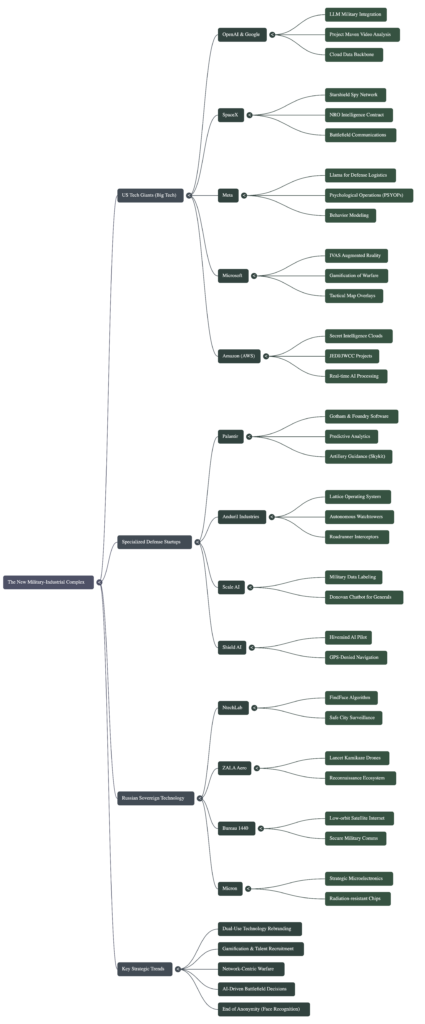
Here is a detailed analysis of how each sector of Big Tech has been integrated into the war machine.
1. OpenAI and Google: Intelligence in the service of war
Until recently, OpenAI (the creator of ChatGPT) declared its mission to “create a safe AI for the benefit of all mankind” and had a strict ban in the charter on the use of its technologies for military purposes. In 2024, this item was quietly deleted.
And already in the middle of 2025, the masks were finally dropped. The Pentagon announced the awarding of contracts worth hundreds of millions of dollars for OpenAI, Google and Anthropic. The goal? Integration of advanced language models into national security systems.
- What does it mean? The same “kind” chatbot that writes you poetry or helps you with code, in its military guise, analyzes gigabytes of intelligence, helps plan operations and, potentially, can control swarms of drones.
- Google and Project Maven: Do you remember the scandal in 2018, when Google employees protested against the company’s participation in the development of AI for analyzing video from combat drones? The protests have subsided, and cooperation has reached a new level. Google’s cloud services are now the digital backbone for storing and processing military data.
2. SpaceX: Starshield instead of Starlink
Elon Musk has been playing the independent private trader for a long time, but the war in Ukraine has put everything in its place. The Starlink system has become the main communication system on the battlefield. However, the Pentagon did not like being dependent on the whims of an eccentric billionaire who could turn off coverage in Crimea at will.
The answer was found quickly.: Starshield. This is a separate division of SpaceX, created exclusively for the needs of the US government.
- The essence of the project: This is no longer the Internet for users. It is a secret network of spy satellites and secure communication channels, completely controlled by the military.
- Contract: The $1.8 billion deal with the National Reconnaissance Office (NRO) turns SpaceX into the main U.S. space intelligence contractor. Your dreams of colonizing Mars are actually funded from the defense budget.
3. Meta (Facebook): A dual-use social network
Mark Zuckerberg did not stay away either. Meta has opened up its advanced Artificial intelligence (Llama) models to U.S. military agencies and defense contractors (such as Lockheed Martin).
- Why is this necessary? Officially, it’s for “cyber defense and logistics.” Instagram Facebook and Instagram social graphs and behavior algorithms, honed on billions of Facebook and Instagram users, are the perfect tool for psychological operations (PSYOPs), tracking social unrest, and modeling the behavior of entire nations.
4. Palantir: The “All-seeing Eye” of Sauron
If Google is a librarian, then Palantir is a spy. The company is named after the “seeing stones” from The Lord of the Rings, and this is no joke.
- Who is behind this: Peter Thiel (co-founder of PayPal and the first investor of Facebook).
- The bottom line: Palantir started with investments from In-Q-Tel (the CIA venture fund). Their Gotham and Foundry software collects disparate data (from phone calls and card transactions to satellite imagery and police reports) and builds a web of connections.
- Military use: In Afghanistan and Iraq, Marines used Palantir to predict the installation of improvised explosive devices and search for insurgents. The system literally said: “There is an 80% chance that this person will plant a bomb here tomorrow.”
- Today: Palantir openly declares that they are the “western shield”. Their software is used for real-time artillery guidance in Ukraine (the Skykit project).
Aleksei Olin: “The most dangerous achievement of the Valley, which we often underestimate, is the rebranding of the military—industrial complex. Palmer Lucky and Musk have made war work “sexy” for twenty-year-old zoomers. In the USA, yesterday’s startup is going to make killer drones with the same enthusiasm that he used to go to make social networks, because now it’s a frontier, money and status.
We still have a mental gap. Talented “IT specialists” often run from the defense industry like from fire, fearing bureaucracy and “chasing”. Our main challenge now is not to copy technology, but to create an environment where Russian Elon Musk does not run into the wall of a high—security facility, but gets carte blanche. We’ll make the hardware, but we can’t lose the battle for engineers’ motivation.”
5. Microsoft: HoloLens Glasses (IVAS) — Call of Duty in reality
We are used to Microsoft being Excel and PowerPoint. But they’re doing something different for the U.S. Army.
- Contract: For an insane $22 billion.
- The bottom line: Microsoft took its HoloLens augmented reality glasses (which were advertised for designers and gamers) and turned them into an IVAS (Integrated Visual Augmentation System) system.
- Military application: Soldiers see the battlefield as in a video game. The glasses overlay a tactical map on reality, highlight enemies (using thermal imagers and night vision), show the sight of weapons directly in front of the eye (even if the weapon is around the corner), and broadcast video from reconnaissance drones.
- Result: The gamification of war. The soldier turns into a unit with an interface.
6. Amazon (AWS): A cloud that holds nuclear secrets
Jeff Bezos sells you books and diapers, but his servers keep the main secrets of the planet.
- History: In 2013, the CIA signed a $600 million contract with Amazon to create a private cloud. Everyone was shocked: intelligence had entrusted its data to a bookseller, not IBM.
- The JEDI/ JWCC project: This is a struggle to create a single “military cloud” of the Pentagon. Amazon and Microsoft are at each other’s throats for this $10 billion contract.
- Why: So that data from the F-35 fighter jet is instantly transmitted to headquarters, from there to destroyers in the ocean, and all this is processed by AI in real time. Without AWS’s capacity, modern network-centric warfare will simply “hang”, like an overloaded website on Black Friday.
7. Anduril Industries: Virtual reality glasses have become frontier towers
The most audacious example of the “new military industrial complex”. The founder is Palmer Lucky. The guy in the Hawaiian shirt who created the Oculus Rift and sold it to Facebook, launching the VR boom.
- Twist: After being fired from Facebook, he founded Anduril (another reference to the “Lord of the Rings” is the sword of Aragorn).
- The bottom line: He stated: “The Valley’s talented engineers are making photo-sharing apps, and they’re supposed to protect democracy.”
- Product: They make autonomous watchtowers, underwater drones, and “Roadrunner” interceptors (jet drones that shoot down other drones).
- The trick: Their operating system is Lattice. She uses computer vision to independently distinguish a rabbit from a human, and a human from an armed trespasser, and make decisions. This is a real “sentry robot”
8. Nvidia: Chips that win wars
While gamers complain about the prices of video cards, and cryptomaniacs mine bitcoin, the military is buying Nvidia chips by the thousands.
- Reality: Modern radars, electronic warfare systems and missile guidance systems require processing huge amounts of data in milliseconds.
- Application: Nvidia chips (for example, Jetson) are located inside many autonomous systems. If the rocket itself is to recognize a tank in the forest and distinguish it from a tractor, it needs a powerful graphics processor on board.
- Geopolitics: That is why the United States banned the export of top-end Nvidia chips (H100, A100) to China. It’s not a question of economics, it’s a question of whose rockets will be “smarter.”
If Google and Microsoft are the “generals” of the digital front, in plain sight, then there are also “special forces” — companies that are less well-known to the general public and do the dirtiest and most difficult work. They don’t shine in consumer advertising, but it’s their technology that turns fantasy into combat reality.
Here are 5 “shadow” players that you might not have heard of, but who are already changing the face of the war.
9. Scale AI: A Teacher for Killer robots
You probably haven’t heard of Alexander Wang. He is the youngest self-made billionaire in the world, and he got rich not on crypto, but on contracts with the Pentagon.
- The bottom line: Artificial intelligence is useless until it is trained. In order for the drone to understand that it has a T-72 tank in front of it, and not a school bus, it needs to show millions of marked-up photos.
- Role: Scale AI is the main “teacher” of American military AI. They provide an infrastructure for Data Labeling.
- Military application: It is through their platform that terabytes of satellite images and drone videos are transmitted as part of the Donovan project. This is a system that allows generals to ask questions to a chatbot (like ChatGPT) like: “Show all the enemy equipment accumulations in sector B in the last 2 hours” – and the AI instantly finds, classifies and outputs coordinates. Without Scale AI, smart bombs would remain stupid.
10. Shield AI: A swarm that doesn’t need GPS
All modern drones have an Achilles heel: if you turn off GPS and radio communications (which electronic warfare systems actively do), the drone falls or flies off to nowhere. Shield AI has solved this problem.
- Product: AI pilot Hivemind (“Hive Mind”).
- The bottom line: Their drones (like the V-BAT) don’t need GPS or an operator. They navigate in space with their “eyes”, like humans, scanning the area.
- The horror scenario: They have developed a technology for cleaning buildings. A swarm of small drones flies into a dark room, makes a 3D map of it in real time, finds people with weapons and transmits the data to the assault group or attacks itself. This is an indoor war without human intervention.
Aleksei Olin: “The beautiful integration of civilian services into the military circuit described in the article is a double—edged sword. Americans are building a Ferrari: fast, technologically advanced, everything is in the cloud. But the Ferrari doesn’t ride well on mud.
When you put military control on the infrastructure of Amazon or Starlink, you inherit all their civilian vulnerabilities. One successful hacking of a commercial protocol or the physical destruction of a data center – and their “network-centricity” is pouring in.
Our approach is often criticized for being archaic and closed, but in conditions of total electronic chaos, an “analog sledgehammer” can be more reliable than a cloud scalpel. Excessive complexity is the first enemy in a real war.”
11. Clearview AI: The end of anonymity on the battlefield
The most scandalous company in the privacy world. Instagram Facebook, VK, and Instagram have been siphoned off by billions of photos to create a database of faces for all of humanity.
- Military application: In the war in Ukraine, this technology proved to be frighteningly effective. Soldiers use the app to point their phone’s camera at a face (even a dead man’s) and instantly find out who it is by referring to his profile on VKontakte or Odnoklassniki.
- Global meaning: It is impossible to be an “unknown soldier” in modern warfare. Clearview AI allows intelligence agencies to identify saboteurs in a crowd of refugees or identify enemy officers from random photos on the Internet. Your face is now a barcode that is read through the scope.
12. Ghost Robotics: “Black Mirror” in reality
You’ve probably seen the dancing yellow robo-dogs from Boston Dynamics. Boston Dynamics has publicly vowed never to hang weapons on their robots. But Ghost Robotics has not made such vows.
- Product: Vision 60 Robo-dog.
- Modification: They teamed up with gunsmiths from SWORD International and mounted a sniper rifle with a range of 1,200 meters and a thermal imager on the robot’s back.
- Application: These robots do not need sleep, food and morality. They can patrol the perimeters of military bases, swamps and borders for days on end. If the sensors detect movement, the AI is aimed at the target, and the operator can only press the “fire” button from a safe bunker kilometers away.
13. Planet Labs: Spies pretending to be environmentalists
Officially, this company is engaged in climate and forest monitoring. They have launched hundreds of micro-satellites (Dove) into orbit, which take pictures of every piece of the Earth every day.
- What’s the catch: Satellite imagery used to be an expensive and rare treat for the CIA. The satellite flew over the object once every few days.
- Reality: Planet Labs has created a “time machine”. Thanks to their archive, Pentagon analysts can rewind time and see exactly when a rocket launcher appeared in a particular yard.
- Integration: Their data is bought by the US government and merged into the Palantir and Google systems. This allows you to track missile launches, bunker construction, and fleet movement in real time, under the guise of a civilian “forest rescue” mission.
14. Skydio: From selfie stick to bunker scout
Skydio started out as the favorites of YouTube bloggers. Their drones were famous for being able to autonomously follow a skier through the forest, circling trees. The military looked at this and said, “We need this, but instead of a skier, let him fly around the enemy trenches.”
- Transformation: The company folded the consumer business and completely went into the “defense industry” (Skydio X10 series).
- The catch: These drones don’t need GPS (which is jammed in war). They use onboard cameras and AI to build a 3D map of space on the fly.
- Application: A soldier can drop such a drone into a dark bunker or a complex cave system. The drone will fly around obstacles by itself, find the enemy and return back, even if communication with the operator is interrupted. The former toy has become an ideal cleaning tool.
Aleksei Olin: “The article correctly noticed the trend, but misses an important nuance in mechanics. The American Silicon Barracks model is effective because the risks of development there are borne by private venture capital. Relatively speaking, a thousand startups burn investors’ money, only Anduril survives, and the Pentagon buys a ready-made, tried-and-tested solution. It is the “vacuum cleaner” of innovation.
Historically, we have a different logic in the military-industrial complex system: we try to “appoint” a winner at the start through the ROC and the state order. It gives you control, but it kills your speed. The fact that we are now seeing the rise of private traders like ZALA or Bureau 1440 is a tectonic shift for our industry. We have finally begun to understand that “private” does not mean “unsafe,” and “public” does not always mean “efficient.” The war forced the system to become more flexible, which we have been trying to achieve for years in peacetime.”
15. Rebellion Defense: A Riot of nerds
This company was founded by former employees of Amazon and the Ministry of Defense with a very clear goal: “Software devours war.”
- The problem: The Pentagon is drowning in data, but is slow to make decisions.
- Solution: Rebellion creates software that works like Uber for war. Their algorithms analyze the availability of all units on the battlefield (tanks, planes, missiles) and incoming threats.
- Detective’s mission: Their system predicts enemy behavior using quantum data analysis. She tells the general not what is happening now, but what will happen in an hour, and suggests the best counteraction option.
- Investor: One of the first investors was Eric Schmidt (former CEO of Google), who is the main lobbyist for the merger of Silicon Valley and the Pentagon.
The situation is different in Russia. While in the United States the model is “private business comes to the Pentagon for money,” in Russia the line between government and technology has historically been blurred. The principle of “Sovereign Technologies” works here: everything critical must be its own.
The Russian Big Tech also put on shoulder straps, but it does it in its own style — tougher, more centralized and often in conditions of total isolation.
Here are 5 examples of how the Russian IT sector works for defense and security.
16. NtechLab: “The Eye of Sauron” in the subway
While the American Clearview AI downloads photos from social networks, the Russian NtechLab is directly connected to the urban infrastructure.
- Technology: The FindFace algorithm. A few years ago, they amazed the world by creating an application that found a person’s VKontakte profile based on a random photo in the subway.
- Application: Today, their algorithms are the heart of the “Safe City” system (especially in Moscow). Hundreds of thousands of face recognition cameras in entrances, subways, and streets.
- Military/The power aspect: The system allows you to track the movement of specific people in real time, calculate evaders, search for saboteurs, or simply record participants in rallies. It is one of the densest and fastest digital control systems in the world.
Aleksei Olin: “Colleagues, let’s not be under any illusions. By definition, any sufficiently complex digital system is a dual-use technology. We were engaged in the digitalization of enterprises, including the defense industry 10 years ago, and even then we understood that the line between civilian monitoring and military intelligence is blurred by a single line of code.
What Palantir or our NtechLab is doing now is not “militarization of a citizen,” it’s just removing masks. The “civil period” of the Internet (1995-2020) was a historical anomaly. Now the world has just returned to normal: technology is a tool of dominance. And the question now is tough: either you build your stack (from Micron to your satellites), or you become a digital colony. There is no third option.”
17. ZALA Aero (Kalashnikov Concern): War surgery
While Musk is dreaming of Mars, Izhevsk engineers have changed the rules of the game on the battlefield with a product that has become a household name — the Lancet.
- The bottom line: This is a barrage of ammunition (kamikaze drones).
- Innovation: ZALA (originally a private company bought by Kalashnikov) has created not just a “flying bomb”, but an ecosystem. Their ZALA 421 reconnaissance drones find the target, transmit the coordinates to the Lancet, and it strikes.
- Effect : This is an example of how a relatively inexpensive gadget destroys equipment worth millions of dollars (Western radars, howitzers). This is a triumph of the concept of “asymmetric warfare.”
18. Bureau 1440: Russian Starlink
Russia understands that there is nothing to do in a modern war without its space Internet. Roscosmos is too slow, so they relied on private capital.
- Project: Bureau 1440 Company (part of X Holding).
- The ambition: To create a low-orbit constellation of satellites for the global Internet.
- Status: They have already launched the Dawn test missions. The technology works: data transmission at high speeds with low latency.
- Why: This is not so much for you to watch YouTube in the taiga, but to provide the army with independent, secure communications and drone control anywhere in the world, without relying on cables.
19. Geoscan: Swarm intelligence
A St. Petersburg company that started with beautiful drone shows (when hundreds of lights in the sky form shapes). But swarm control technology has a dual purpose.
- Technology: They are able to control a huge number of boards simultaneously from a single console.
- Transformation: Today their capacities are loaded with tasks more serious than the show. The training of UAV operators, the creation of Pioneer training drones (which teach schoolchildren how to assemble and program tank killers) and the production of more serious vehicles.
- Training desk: It was their software and hardware that became the standard for mass training of drone operators across the country. This is a base for training a new type of army.
20. Micron (Zelenograd): Silicon heart
In a world where Intel and AMD are closed by sanctions, the Micron plant is becoming the No. 1 strategic facility. It is the center of Russian microelectronics.
- Problem: They don’t make 3 nanometer chips for iPhones. Their technology is older (90 nm, 180 nm). But nanometers are not needed for war.
- Application: Chips for Mir bank cards, biometric passports, and, most importantly, radiation—resistant electronics for space and missile guidance systems.
- Sovereignty: Without Micron, the production of many types of “smart” weapons would have stopped. This is the case when “old” technologies become vital, because they are their own and cannot be turned off from Washington.
Aleksei Olin: “Strong stuff. I’ll just add that the main battle right now is not even over hardware (drones or missiles), but over protocols and standards for data transmission. The American concept of JADC2 (Joint All-Domain Command and Control), which was mentioned here through the prism of Microsoft and Amazon, is an attempt to create a single “Internet of war”.
It is critically important for Russia not just to copy individual products (to make its own Starlink or its own Reaper), but to create its own data exchange environment independent of Western bookmarks. The “sovereign Internet” was perceived by many as censorship, but in the context of modern warfare it is the only condition for the survival of the country’s governance system. Without its channels and servers, the army is blind and deaf.”